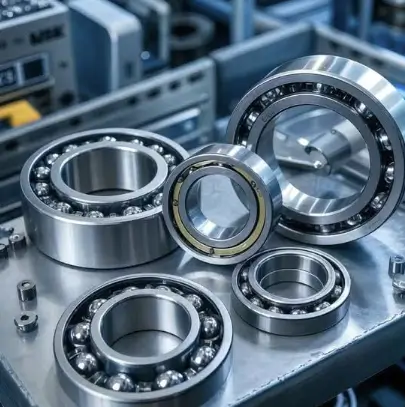
Bearings are used throughout vehicles and industrial equipment to support rotating components, reduce friction, and maintain accurate movement. However, choosing a replacement bearing can be challenging when the original part number is missing, worn away, or difficult to read. A photograph or a rough measurement may help narrow the possibilities, but it rarely provides enough information to confirm the correct component.
A reliable identification process combines dimensional measurements, application details, manufacturer markings, and technical specifications. This approach reduces the risk of ordering a bearing that fits physically but cannot withstand the loads, speeds, or environmental conditions of the intended equipment.
Why Application Identification Matters
The first step is to establish where the bearing is installed and what it does. A bearing in an electric motor may face different loads and speed conditions from one in a wheel hub, transmission, accessory assembly, or industrial fan.
Even when two bearings have similar dimensions, they may differ in internal clearance, sealing, cage construction, material, precision class, or load capacity. Those differences can influence service life and operating performance.
When someone asks what car is this for the question highlights an important identification issue: a bearing designation alone does not necessarily establish the exact vehicle application. Compatibility depends on the complete assembly, model year, engine or drivetrain variant where relevant, and the manufacturer’s parts information.
Start with the original part number
If possible, record all markings on the bearing, including letters, numbers, and suffixes. Photograph the markings before cleaning the part, especially if they are faint. Cross-reference the complete designation using a reliable manufacturer’s catalogue or vehicle parts database.
Do not assume that a partial number is sufficient. Prefixes and suffixes may indicate a different seal, clearance, cage, tolerance, or other design feature. A small difference in designation can matter when the bearing operates under specific conditions.
Measuring a Bearing Correctly
When markings cannot be read, measure the bearing’s principal dimensions:
- Bore diameter: the diameter of the opening that fits over the shaft.
- Outside diameter: the diameter of the outer ring.
- Width: the overall axial width of the bearing.
Use suitable measuring equipment and take measurements carefully. Dirt, corrosion, damaged edges, and worn surfaces can affect results. If precision is important, a technician should verify the dimensions with calibrated tools.
Dimensions can help identify a likely series, but they should not be treated as final proof of compatibility. Bearings with the same basic dimensions can have different internal designs or application requirements.
See also: Building a Claims QA Framework That Delivers 97% Technical Accuracy
Understanding Deep Groove Ball Bearings
Deep groove ball bearings are widely used because their construction is relatively simple and versatile. They generally support radial loads and can also accommodate axial loads in both directions within the limits of the particular design.
The 618 series includes thin-section deep groove ball bearings, which can be useful where space and weight are important design considerations. However, a thin-section design is not automatically suitable for every high-load application. Engineers must compare the actual load, speed, stiffness, and dimensional requirements against the manufacturer’s data.
Seals and shields
Some bearings are open, while others include shields or contact seals. These features affect contamination protection and friction. An open bearing may depend on external lubrication and sealing, whereas a sealed bearing can help retain lubricant and limit the entry of contaminants.
The correct choice depends on the application. Dust, moisture, high temperatures, and maintenance access should all be considered before selecting a replacement.
Clearance and precision
Internal clearance influences how the bearing behaves once mounted and operating. Precision requirements may also differ between general equipment and assemblies requiring controlled runout or low vibration. Selecting the wrong clearance or precision class may lead to noise, heat, or reduced performance.
Verify Automotive Compatibility Before Purchase
For automotive use, confirm the vehicle’s make, model, model year, engine or drivetrain configuration, and the exact location of the bearing. A vehicle may have multiple versions of the same assembly across different production years or markets.
Use the vehicle manufacturer’s parts catalogue, a reputable supplier’s compatibility system, or a qualified mechanic to verify the part. If the bearing is being replaced as part of a larger assembly, check whether the manufacturer recommends replacing a complete unit rather than an individual bearing.
Never select a vehicle bearing based only on appearance. An incorrect part may create noise, vibration, premature wear, or unsafe operating conditions. Critical components should be installed by a qualified technician using the specified tools and procedures.
Common Identification Mistakes
One frequent mistake is measuring only the bore diameter. The outside diameter and width are equally important, and the internal specification may be just as critical.
Another mistake is assuming that a bearing used in one vehicle will fit a similar model. Manufacturers may change components between trims, engines, production years, or regional versions. It is also risky to rely solely on marketplace listings that do not show the complete part number or supporting specifications.
Finally, avoid installing a replacement without checking the cause of the original failure. Misalignment, contamination, improper mounting, inadequate lubrication, and damage to the housing or shaft can destroy a new bearing.
FAQs
1. Can I identify a bearing from a photograph?
A photograph can help identify visible markings and general design, but it usually cannot confirm all dimensions, internal specifications, or vehicle compatibility.
2. Are bearings with the same dimensions interchangeable?
Not necessarily. Seals, clearance, precision, load ratings, materials, and internal design may differ even when the principal dimensions match.
3. What information is needed to find an automotive bearing?
Provide the complete part number if available, vehicle make and model, model year, engine or drivetrain details where relevant, bearing location, and accurate dimensions if the number is unreadable.
Conclusion
Correct bearing identification requires a combination of application details, dimensional checks, and reliable technical references. Deep groove ball bearings serve many mechanical purposes, but the right version must match the design and operating conditions of the equipment. Confirming the complete specification before purchase helps prevent avoidable replacements, performance problems, and installation risks.