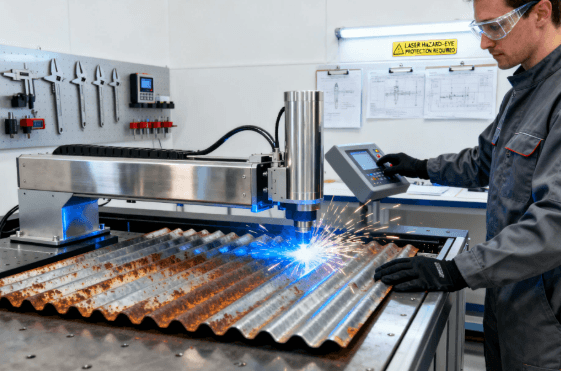
Industrial cleaning requirements vary widely. A workshop may need to remove corrosion from fabricated parts, prepare surfaces for refinishing, or clean selected metal components before further processing. The best equipment must provide suitable cleaning performance while protecting the underlying material and fitting the facility’s production requirements.
When evaluating a higher-powered laser system, manufacturers should look beyond the wattage rating. The actual result depends on the cleaning application, surface condition, laser configuration, and operating procedure.
Defining the Cleaning Requirement
The first step is to identify the contaminant and the surface that needs treatment. Rust, paint, oxide layers, and manufacturing residues can respond differently to laser energy. Their thickness, composition, and adhesion also affect the cleaning process.
The substrate matters just as much. A robust steel component may tolerate a different treatment approach from a thin metal part or a precision surface. Before selecting equipment, define the acceptable condition of the cleaned material and determine whether the process must preserve coatings, dimensions, texture, or other surface characteristics.
Clear requirements make equipment comparisons more meaningful and help avoid purchasing a machine that is unsuitable for the intended task.
What a 2000-Watt Rating Means
A 2000-watt rating indicates nominal laser output power, but it does not independently determine cleaning speed or quality. Beam delivery, operating mode, scanning pattern, working distance, contaminant properties, and substrate characteristics all influence the final result.
Higher output may be relevant for some applications, but more power is not always preferable. Excessive energy or inappropriate settings can alter the underlying surface, especially when the component is thin, sensitive, or unevenly contaminated.
Manufacturers should request application-specific information and verify the machine’s capabilities through a controlled trial.
For businesses comparing available equipment, the Clyertek 2000w laser cleaning machine provides a product reference for evaluating a 2000-watt configuration and its suitability for selected cleaning requirements.
Understanding the Importance of Beam Control
Laser cleaning involves moving the beam across the workpiece in a controlled pattern. The way energy is distributed affects coverage, treatment time, and surface results.
A wobble or scanning configuration may provide a broader treatment pattern than a narrowly focused path, depending on the equipment design. However, the usable cleaning area and achievable result must be confirmed from the manufacturer’s specifications and practical testing.
Operators should learn how to maintain a consistent working distance and scanning pattern. Irregular movement can create uneven treatment, while excessive overlap or inappropriate settings may affect the substrate.
Potential Industrial Applications
Rust removal from suitable metal surfaces
Corrosion removal is a common reason to evaluate laser cleaning. A suitable system may remove selected rust layers and prepare metal for further inspection or finishing.
However, cleaning does not restore material lost through corrosion. Deep pitting, reduced thickness, and structural damage require separate assessment before the component is returned to service.
Preparation before coating
Surface cleanliness can affect coating adhesion and long-term performance. Laser cleaning may be appropriate for certain metal surfaces before refinishing, provided the resulting surface meets the coating manufacturer’s requirements.
A successful trial should assess both visible cleanliness and any surface characteristics needed by the coating process. Additional preparation may still be required.
Maintenance and refurbishment
Reusable fixtures, machinery components, and metal assemblies may require periodic cleaning. A laser system can be considered when the contaminant and substrate are compatible and the process can be performed safely.
The business should evaluate whether the equipment can access the required areas without exposing nearby sensitive components to unwanted treatment.
How to Evaluate the Complete System
Equipment selection should include more than nominal output power. Review the cleaning head, scanning capabilities, cooling arrangement, controls, working distance, accessories, and maintenance requirements.
Also consider the types of surfaces the system supports, the expected cleaning area, operator training, and access to technical service. Confirm electrical and installation requirements before planning the work area.
A supplier demonstration should use representative workpieces with typical contamination. Record the cleaning time, finished surface condition, consistency, and any additional steps needed before the next production stage.
Safety and Operational Controls
Laser cleaning can expose workers to direct or reflected laser radiation. Treatment may also generate airborne particles or fumes from rust, paint, coatings, and other deposits.
A documented risk assessment should establish the appropriate laser-controlled area, enclosure and interlock requirements, warning indicators, access restrictions, protective eyewear, and extraction arrangements. The controls must match the specific equipment and materials being processed.
Operators need training in setup, scanning technique, shutdown, emergency response, and routine checks. Unknown coatings should be assessed before treatment, and the equipment should only be used within its specified operating limits.
Assessing Productivity and Cost
To determine whether a higher-powered system is worthwhile, compare it with the current cleaning method using representative jobs. Track labour time, cleaning rate, surface quality, rework, consumable use, and waste-handling requirements.
The financial analysis should include the machine, installation, training, safety infrastructure, ventilation, maintenance, and downtime. A faster cleaning stage may offer limited value if setup or inspection becomes more complicated.
Documenting results across several workpieces gives the business a stronger basis for deciding whether the proposed system meets its needs.
Frequently Asked Questions
1. Does a 2000-watt laser clean every surface faster?
No. Cleaning performance depends on the substrate, contaminant, beam configuration, settings, and required finish. Higher output alone does not guarantee a better result.
2. Can laser cleaning remove deep corrosion?
It may remove surface corrosion, but it cannot restore metal lost through deep rust or pitting. Damaged components require separate inspection.
3. What is the best way to evaluate a higher-powered system?
Run a controlled trial on representative workpieces. Measure cleaning time, inspect the finished surface, verify material compatibility, and include safety and operating costs in the comparison.
Conclusion
Higher-powered laser cleaning equipment may suit selected industrial surface-preparation tasks, but its effectiveness depends on the application rather than wattage alone. Manufacturers should define their cleaning requirements, test representative materials, and compare the complete operating workflow before making a purchase. With appropriate process controls, inspection, and laser safety measures, businesses can make a more informed decision about integrating this technology into their operations.